

Chord Phono ARAY
One of the most critical interfaces through which the extremely delicate electrical signal generated by an MC cartridge passes is the tonearm and the 5-pin DIN output connector located at its rear. Inside an MC cartridge, there are separate coils wound independently for the left (L) and right (R) channels. Each of these coils has its own signal (+) and return (–) path. In other words, the left and right channels each have completely independent signal and return paths.
The negative (–) path within this structure is commonly referred to as “ground”; however, its function goes far beyond serving as a simple return path. From the perspective of the phono stage, this line represents a critical reference point that defines both signal level and timing. For this reason, the connection geometry at the tonearm output, contact quality, and the electrical calmness of the return path play a decisive role in ensuring that the extremely low-level information produced by an MC cartridge is transmitted accurately and without degradation.

5-Pin Din Socket

Cartridge Pins
MC cartridges operate without any external power supply; they function entirely as mechanically driven, differential-output alternating current generators. As the stylus traces the grooves of the record, the coil moves within a magnetic field. This mechanical motion generates an electrical voltage according to Faraday’s law of induction. The resulting signal is alternating current (AC): its frequency represents the musical information, while its amplitude is extremely low (approximately 0.2–0.5 mV).
Viewed from this perspective, all MC cartridges are, by design, differential (balanced) mechanisms. Separate coils for the left and right channels generate independent + (signal) and – (return) paths for each channel. In practice, however, this advantage cannot be fully exploited in most systems. The primary reason is that the vast majority of tonearm cables and phono connections are based on RCA (unbalanced) architecture. As a result, this extremely delicate, differentially generated signal is reduced to a single-ended (unbalanced) topology at the very first stage of the signal chain.

Chord PhonoARAY
Now let us turn to one of the central topics of this article: the fifth connection. As already discussed, the signal produced by an MC cartridge exists at extremely low levels. Such a sensitive environment is highly vulnerable to external influences such as electromagnetic interference, micro potential differences across the chassis, static electricity, and RF (radio frequency) noise. This is precisely where the fifth pin, located at the rear of the tonearm, comes into play.
The fifth pin allows static electricity accumulated in the metal structure of the tonearm—and in some designs, the turntable chassis itself—as well as unwanted electrically induced charges from the surrounding environment, to be discharged in a controlled manner without contaminating the signal path. This line is not intended to carry musical signal; rather, it is designed to calm the electrical environment upon which the signal is referenced and to help keep the return paths electrically stable. In doing so, the extremely low-level signal generated by the MC cartridge can reach the phono stage without being masked by external noise.
Turntables, tonearms, and many other components in the analog chain are predominantly metal structures and can therefore collect static electricity and high-frequency electromagnetic energy from their environment. When left uncontrolled, this accumulated static charge and RF content can couple capacitively into the signal paths. The phono stage then interprets these unwanted electrical components alongside the musical signal and amplifies them as if they were part of the music itself.
As a result, the problem manifests not merely as audible noise, but as a degradation of timing accuracy, masking of transients, and a general restriction of musical flow.
Chord PhonoARAY
The purpose of grounding devices is not to carry musical signal, but to provide a controlled discharge path and a stable reference point for static and high-frequency electrical noise that interferes with the signal. For this reason, whether active or passive, grounding solutions typically operate through a thin ground wire. The audible effect is less about hum suppression and more about preserving low-level information and electrically calming and stabilizing the signal return path.
Consequently, the L– and R– return references used by the phono stage become more stable and predictable once uncontrolled RF and static electrical noise is removed.
From a technical standpoint, electrical noise will always seek the path of least resistance. This can be compared to water flowing downhill along the steepest slope or smoke escaping through the most open passage. Unwanted electrical noise behaves in much the same way, favoring paths with the lowest impedance and resistance.
The internal structure of grounding devices is designed precisely around this principle. The use of resistive networks, damping structures, and frequency-dependent components slows down high-frequency noise, disperses its energy, and prevents reflection back into the signal path. RF noise is rendered ineffective by being converted into heat, attenuated, and absorbed. As a result, noise is directed into the device and effectively “lost” there, without returning to the signal path.
One of the most critical benefits of this process is the stabilization of the reference point. When the L– and R– return references are freed from noise, the phono stage’s measurement baseline becomes calmer and timing accuracy improves significantly. The effect perceived by the listener is not limited to a darker background; musical flow becomes more relaxed, transients emerge more clearly, and rhythmic coherence is perceived far more strongly.

Chord PhonoARAY
After these technical considerations, let us turn to the subject of this review: The Chord Company PhonoARAY turntable earthing system. Founded in the United Kingdom in 1986, The Chord Company distinguishes itself by approaching cable design not merely as signal conduction, but as an integrated electrical, mechanical, and electromagnetic system. Guided by this philosophy, the company has conducted decades-long R&D into the relationship between mechanical vibration and electrical behavior, as well as the interaction between high-frequency interference and signal paths.
In the past, I used active grounding solutions from manufacturers such as Synergistic Research and Telos for many years. At the time, the electrical infrastructure of the house I lived in made such devices almost a necessity. In my current system, however, I have not experienced any obvious grounding-related issues to date, and as a result, active or passive grounding solutions had long fallen outside my area of interest. When I borrowed the PhonoARAY from Extreme Audio for evaluation, I must admit that I had serious doubts about whether it could make a meaningful contribution to my system.
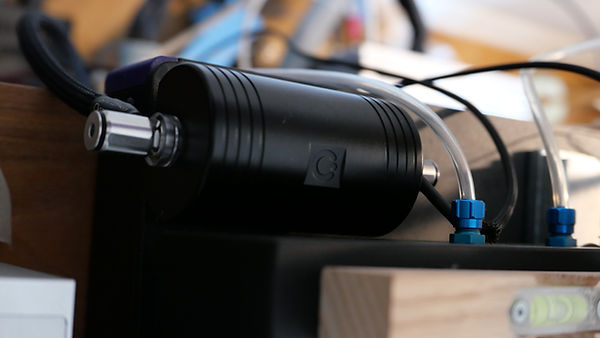
The Chord PhonoARAY is presented in an exceptionally elegant and carefully designed package. The moment you hold it in your hand, the manufacturer’s attention to detail is immediately apparent. Measuring approximately 10 cm in length, it features a cylindrical body that feels surprisingly heavy for its size. Included with the device is a roughly 50 cm long, thick, shielded ground cable; this cable helps prevent the ground path itself from acting as an antenna and allows unwanted electrical noise to be discharged in a more controlled manner.
PhonoARAY is a fully passive device with no electrical power connection. There is a binding post at each end of the unit. The grounding spade from the tonearm cable connects to one end of the device; in my setup, I also connected the separate grounding wire coming directly from the turntable to the same post. From the other end, the supplied shielded cable connects to the grounding post of the phono stage. Once these steps are completed, installation is extremely straightforward and takes only a few minutes.

Connection Scheme
The moment I placed the first record on the platter and lowered the stylus, the effect I encountered went well beyond my expectations. An increase in background silence was an anticipated benefit; what truly surprised me was the transformation in the system’s dynamic behavior. Transient response became noticeably faster, and both micro- and macro-dynamic contrast increased significantly. The presentation became more vivid, more authoritative, and far more stable in terms of timing. In particular, low-frequency control and the overall sense of “drive” felt as though the mechanical character of the turntable had fundamentally changed—evoking the instant torque and stability typically associated with a direct-drive system. Frankly, I did not expect such an effect from a passive grounding solution.
So what makes the Chord PhonoARAY different? Its impact stems not from dramatically lowering the noise floor, but from stabilizing the return paths that the phono stage uses as its reference by removing electrical noise. Once the reference point is calmed, transient timing becomes clearer. Attacks occur without delay, and rhythmic structure locks in far more precisely. This is perceived during listening as a faster, more energetic, and more authoritative presentation. As reference stability increases, transient starting points become more defined, micro-delays disappear, and the music begins to flow with a controlled yet natural sense of momentum—very much like the character one associates with a well-executed direct-drive turntable.

Soular Energy
The album Soular Energy is one of the clearest demonstrations in jazz history that the double bass can be not merely an accompanying instrument, but the central narrator of the music itself. This Ray Brown Trio recording is built not on grand gestures or flashy production, but on timing, balance, and natural flow. Cry Me a River represents this philosophy in its purest form: the music draws you in gently, never rushes, and captivates the listener through subtle nuance. Precisely because of this simplicity, it reveals the true character of a system without disguise.
With PhonoARAY in the system, the change in this track is not perceived as an immediate “change in sound,” but rather as the music beginning to flow more freely and coherently. The pizzicato attacks of the double bass are clearer, with more stable note onsets. The bass does not grow larger or push forward; it simply becomes tighter, more controlled, and more self-assured. Ray Brown’s relaxed yet authoritative walking line becomes more apparent. The rhythm locks in more securely, and the music progresses with greater balance. The track does not play faster, yet it flows with noticeably greater vitality. It feels as if a thin veil had previously been present—and once lifted, direct eye contact with the instruments is suddenly established.

Tchaikovsky: 1812 Overture
Tchaikovsky: 1812 Overture, performed by the Chicago Symphony Orchestra under the direction of Fritz Reiner, is one of the most well-known and frequently referenced orchestral recordings in the Living Stereo series. Rather than relying on sensational effects, this interpretation stands out for its balanced presentation of orchestral mass, soundstage depth, and dynamic scale. The quiet opening, the gradually intensifying orchestral texture, and the dramatic climax clearly reveal both the micro- and macro-dynamic capabilities of an analog chain.
With PhonoARAY engaged, the first noticeable difference in this recording is the orchestra’s more precise and stable placement within the soundstage. The calm progression of the strings at the rear becomes more orderly, while the entrances of the woodwinds are more clearly articulated. As the orchestra grows, the music expands without losing cohesion; layers progress by leaning into one another rather than collapsing. During large dynamic surges, body is preserved and the brass remains powerful without becoming harsh. The soundstage does not merely grow larger—it gains weight, control, and a more convincing sense of solidity.

Schubert: Forellenquintett (Trout Quintet)
Schubert: Forellenquintett (Trout Quintet) is one of the recordings that best conveys the intimacy and magic of chamber music. The Allegro Vivace movement establishes the music’s energetic yet never aggressive character through continuous and natural dialogue between the instruments. Emil Gilels’ piano presence—clear yet never exaggerated—combines with the rich texture formed by the Amadeus Quartet and double bass to create a performance in which not only the notes, but the physical presence of the instruments themselves, is vividly perceived.
With PhonoARAY in the system, the first sensation is a clearer and more three-dimensional presentation of the instruments within the soundstage. The violins are not merely positioned to the left as flat images; they stand there with body, bow movement, and volume. The piano occupies the center not as a two-dimensional outline, but as a real instrument with depth and weight. The double bass ceases to be a background “sound” and is perceived together with its wooden body. As the music accelerates, nothing overlaps or smears; the instruments progress as an organic whole. Liveliness increases, yet naturalness and balance are never lost.
Chord PhonoARAY is not an accessory that radically transforms a system or dramatically alters its sonic character. Its effect is not about enlarging the music, but about returning it to where it should naturally reside. Timing becomes clearer, instruments more stable, and the soundstage more settled—without any artificial emphasis drawing attention to itself. If you have invested in your analog chain, understand its setup, and take pleasure in subtle differences between recordings, PhonoARAY does not present you with a new sonic signature; instead, it helps reveal your system’s existing potential with greater consistency and accuracy. That is precisely where its true value lies.
PhonoARAY’s contribution lies in reminding us that grounding is about more than “noise reduction”—it underscores how critical timing truly is. When the return reference calms down, music forms at the right moment; transients arrive without delay, and rhythmic structure locks in more naturally. The soundstage becomes more stable, the presentation more vivid and convincing.
For listeners who are deeply familiar with their analog chain and appreciate the impact of fine adjustments, what PhonoARAY offers goes comfortably beyond its price-to-performance expectations.
In my system, its greatest impact was not merely technical, but personal: it made me want to rediscover my entire record collection, listening again from start to finish.
Stay with the music.